Dog Collars for Tiny Dogs: Your 6"–10" (15–25cm) Size Guide
If you've just measured your dog's neck and landed somewhere between 6 and 10 inches - you're in the right place. This guide is for owners fitting an extra small dog collar for the first time: the Chihuahuas, the Yorkies, the Italian Greyhounds, and all the other tiny creatures who take up exactly the right amount of sofa space.
We'll walk you through which breeds typically fall in this range, how to get an accurate measurement when your dog has other ideas, why collar width matters more than most guides will tell you, and how to keep that little neck safe. Part of our full dog collar size guide → series.
The Forever XS Club
Here's something that surprises a lot of first-time toy dog owners: the 6"-10" (15-25cm) range isn't just for puppies. For many of the UK's most popular small breeds, it's the size they'll wear for their entire life.
Your adult Yorkie won't suddenly develop a bigger neck. Your Italian Greyhound is as slender at five as they were at one. These dogs are simply, perfectly, small - and so are their collars. That's genuinely reassuring if you're buying your first collar for a toy breed, because it means the right fit now is likely the right fit for years to come.
Here's how the most popular toy and miniature breeds typically measure up:
Yorkshire Terrier 8-10" 20-25cm Adults; puppies at 6 months typically 6-8"
Chihuahua 8-13" 20-32cm Smallest adults and all puppies fit this range
Italian Greyhound 8-11" 20-28cm Measure at the narrowest point, just behind the ears
Chinese Crested 8-11" 20-28cm Hairless variety benefit from soft, smooth-lined collars
Pomeranian 10-14" 25-36cm Smaller adults sit at the 10" end
Toy Poodle 8-14" 20-36cm Smaller individuals and all puppies fit this range
Papillon 8-12" 20-30cm Most adults comfortably within this bracket
Maltese (puppy) 8-12" 20-30cm Puppies start lower; adults tend toward the upper range
These are typical averages drawn from practical collar sizing guides - your individual dog may fall slightly outside the range, which is exactly why measuring always beats guessing.
How to measure a tiny, wriggly dog's neck
In theory, measuring a small dog's neck is straightforward. In practice, it involves a creature with approximately zero interest in holding still.
Use a soft fabric tape measure. A metal one will alarm your dog immediately, and understandably so. If you don't have a fabric tape, use a piece of string or ribbon - mark where it meets with a pen, then hold it flat against a ruler.
Measure where the collar will actually sit - mid-neck, not right under the jaw and not down near the shoulders. Hold the tape snug to the skin, but not so tight you're squeezing.
Measure twice. A dog looking up has a meaningfully different neck circumference to one with their head level. Take two readings and go with the larger of the two.
Try after a walk or a meal, when your dog is more settled. You'll get a calmer few seconds to work with.
For Pomeranians and Toy Poodles: always measure to the skin, not the fur. Their thick coats can compress a surprising amount under a collar - measuring over the coat will give you a reading that's too generous.
For Italian Greyhounds specifically: measure at the narrowest point of the neck, just behind the ears and below the jaw. Their necks taper dramatically, and a collar sized for the wider base can slide forward and slip right over their head.
More on getting this right in our dedicated guide to measuring your dog's neck →.
The measurement most owners forget
You've measured the circumference - good. But have you thought about width?
For toy and miniature breeds, collar width matters just as much as collar length. A collar designed for a medium or large dog - typically 25mm (1") wide or more - sits heavy on a tiny neck. It can restrict the dog's head movement, press awkwardly against the shoulder blades, and create far more pressure against the throat than the dog needs.
The sweet spot for most toy breeds is 15mm (roughly ⅝") to 19mm (¾"). At this width, a collar holds an ID tag comfortably and keeps its position without overwhelming a small frame.
Our handmade biothane collars are available in narrower widths and are particularly well-suited to this size range. Biothane is lightweight, completely waterproof, and wipes clean in seconds - which, given British weather, is a practical bonus even for a dog who'd really rather not go out in the rain.
The two-finger rule - with a tiny-dog tweak
The two-finger rule applies here just as it does for any collar: once fitted, slide two fingers (index and middle, held flat together) between the collar and your dog's neck. They should slide in comfortably - not forced, not rattling around loose.
For the very smallest toy breeds - particularly petite Chihuahuas - experienced fitters sometimes suggest a slightly snugger fit, using one finger rather than two. The reason: tiny dogs can occasionally get a paw behind a two-finger-loose collar, which can cause real distress if they can't get it free. It's not a hard rule, but worth bearing in mind if your dog is particularly small.
Always check fit against skin, not fur. And for puppies under six months, re-check the fit weekly - they grow fast in that early window, even the ones who'll end up very small.
A small dog's neck deserves a little extra care
Most UK vets and dog trainers recommend the same setup for toy breeds: a collar for identity, a harness for walks.
Chihuahuas, Yorkshire Terriers, Pomeranians, and Toy Poodles are among the breeds with a known predisposition to tracheal collapse - a condition where the cartilage rings of the windpipe weaken over time. Even a correctly fitted collar can aggravate this if it's regularly under tension during walks. A harness distributes that pressure across the chest instead, which is much kinder to a fragile neck.
This doesn't mean your dog shouldn't wear a collar at all. UK law requires dogs to wear an ID tag in public, and a lightweight, well-fitted extra small dog collar is exactly the right place for it. Think of it as: collar for ID, harness for walks.
Some owners of small dogs also use a breakaway collar for unsupervised time at home. These have a safety-release clasp designed to open under a set pressure (around 5 lbs / approximately 2.3kg), so the collar releases before it can cause harm if it snags on something. They're not suitable for attaching a lead, but for indoor wear and crate time, they offer useful peace of mind.
What if your dog measures 9"-10"?
If your dog sits at the upper end of this range - 9 to 10 inches (23-25cm) - it's worth having a look at our 8-11 inch collar size guide → too. A collar with a wider adjustment range gives you more flexibility as your dog grows or changes weight across the seasons, and you'll have more choice of styles and hardware in that slightly larger bracket.
Handmade extra small dog collars, made in the UK
Every collar at Dottie's is made by hand, here in the UK - and this size range, with the narrower widths that small dogs actually need, is one we know well. From cheerful prints to clean, practical biothane, each one is made with small necks in mind.
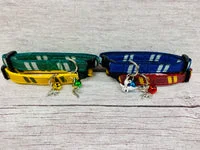
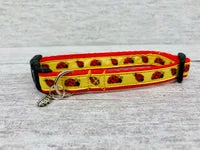
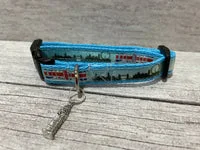
Not sure what you're after? Browse the full range or get in touch - we're always happy to help find the right fit.
Need a different size? Head back to How to Measure Your Dog's Neck for a Collar → to find your range.