Dog Collars for Spaniels & Medium Dogs: Your 12"–16" (30–41cm) Size Guide
If you've got a Cocker Spaniel with gloriously floppy ears, or a French Bulldog whose neck appears to be roughly as wide as the rest of their body - congratulations, you've found the right page. The 12"-16" (30-41cm) range covers collar sizes for some of the UK's most popular and best-loved breeds, and getting the fit right matters more than you might expect.
A quick note on what these numbers actually mean: a 12"-16" collar adjusts to fit neck circumferences between 12 inches (about 30cm) and 16 inches (about 41cm). If your dog's neck measurement falls anywhere in that window, this is your size category. If you're not yet sure how to measure, our collar measuring guide → walks you through it step by step.
Which breeds fit a 12"-16" collar?
Here's a handy reference for the most common UK breeds in this size range. These are typical adult measurements - always measure your own dog, as there's natural variation within every breed.
French Bulldog 12-16" (30-41cm) Average ~14" (35cm); measure at the widest point
Cocker Spaniel 12-16" (30-41cm) Most adults; long coat can affect apparent measurement
Pug 12-16" (30-41cm) Brachycephalic breed - see fit notes below
Lhasa Apso 12-16" (30-41cm) Measure at skin level under the coat
Whippet 13-15" (33-38cm) Sighthound anatomy - see special notes below
Welsh Corgi (Pembroke) 14-16" (36-41cm) Surprisingly thick neck for their compact, low build
Border Terrier 12-14" (30-36cm) On the smaller end of this range
Miniature Schnauzer 12-14" (30-36cm) Larger adults may measure up to 16" (41cm)
Beagle 14-16" (36-41cm) Smaller adults; larger Beagles may need the 16-20" range
Bichon Frise 14-16" (36-41cm) Smaller adults; always measure under that fluffy coat
If your dog measures under 12", our [page:dog-collar-size-10-14-inches text="10"-14" collar size guide"] is the better starting point. If they measure over 16", head to the [page:dog-collar-size-16-20-inches text="16"-20" guide"] instead. And for the full overview of all sizes, the complete dog collar size guide → has you covered.
Getting the fit right: the two-finger rule
Whatever breed you have, the fitting principle is the same: once the collar is on, you should be able to slide two flat fingers between the collar and your dog's neck. Not one, not three - two.
If only one finger fits, the collar is too tight and putting uncomfortable pressure on your dog's neck. If three or more fingers slip in easily, it's too loose - which is an escape hazard, especially for dogs who are prone to pulling backwards or ducking out of a collar.
It's worth making this a regular habit. Check the fit weekly for puppies who are growing quickly, and at least monthly for adult dogs. Coat thickness can also change the apparent fit between seasons, so an autumn once-over is never a bad idea - particularly for the fluffier breeds at the bottom of this table.
French Bulldogs and Pugs: getting the fit right for flat-faced breeds
French Bulldogs are the UK's third most registered breed - 13,789 Kennel Club registrations in 2024 alone - and Pugs aren't far behind. If you're here for one of these two, you're in excellent company.
Both are brachycephalic breeds, which means they have shorter airways and slightly compressed respiratory tracts. This doesn't mean they can't wear collars - the vast majority of Frenchies and Pugs wear them perfectly happily. But it does mean the positioning and fit matter more than they do for other breeds.
Positioning
The collar should sit towards the base of the neck, away from the throat and windpipe. You don't want it riding up towards the jaw. Low and level is the goal.
Width matters
A wider collar distributes any pressure across a broader surface area, which reduces the force on any one point when your dog pulls or strains. Our handmade biothane waterproof collars work well here - the smooth, flat material sits flush against the neck without any rough edges or stitching that could cause irritation.
Consider a harness for walks
Many vets and experienced Frenchie owners use a collar purely for ID tags and opt for a harness when lead walking. That said, a correctly fitted flat collar at the right position is perfectly appropriate for most brachycephalic dogs.
One thing to be aware of: French Bulldogs have disproportionately thick, muscular necks for their body size. Owners frequently underestimate the size they need based on how their dog looks. The average Frenchie neck is around 35cm (14"), but the range runs from 30-41cm (12-16"). Measure, don't guess.
Whippets: why a martingale collar can be a game-changer
The Whippet is one of Britain's most iconic breeds - elegant, gentle, and quietly eccentric in the best possible way. They also have a very specific collar challenge that every Whippet owner tends to discover fairly quickly.
A Whippet's neck is actually wider than their head. In everyday life this isn't a concern, but it does mean a standard flat buckle collar that fits comfortably around the neck can - and often will - slip straight over the head if the dog dips their nose or backs away. It's an escape risk that catches many first-time Whippet owners off guard.
The martingale collar
A martingale collar is a two-loop design: the main collar sits around the neck, and a smaller control loop attaches to the lead. When a dog pulls or tries to back away, the control loop tightens the main loop just enough to prevent slipping - not enough to cause any choking. When the tension releases, the collar relaxes back to its open position. It was designed specifically for sighthounds, and it does the job brilliantly.
When fitting a martingale on a Whippet, measure at the narrowest point of the neck - behind the ears and under the chin - rather than at the base. This is the point the collar needs to hold against. A correctly fitted martingale should tighten to snug when taut, but the D-rings should never fully close together.
A typical adult Whippet neck measures 33-38cm (13-15"), though individuals vary.
Cocker Spaniel collar size: what UK owners need to know
The Cocker Spaniel is the UK's second most popular dog breed, with 23,177 Kennel Club registrations in 2024. Most adult English Cocker Spaniels fit comfortably within this 12"-16" (30-41cm) range, though the breed's full measurement spread extends a little further in either direction.
Individual variation matters here. If your Cocker has a particularly luxuriant coat - and many do - make sure to measure at skin level, not over the fur. The coat alone can add several centimetres to the apparent measurement and lead you to size up unnecessarily.
A few more breeds worth knowing
Welsh Corgi (Pembroke)
Don't let the low-slung stature fool you. Corgis have surprisingly robust, muscular necks - typically 36-41cm (14-16"). Many owners are initially surprised to find their Corgi needs a bigger collar than expected based on their height alone.
Bichon Frise and Lhasa Apso
Both of these fluffy companions can make neck measurement genuinely tricky. The rule is simple: part the coat and measure at skin level. The collar fits the dog, not the fluff.
Border Terrier
A compact, spirited little dog with a neck that typically sits at the smaller end of this range - 30-36cm (12-14"). Some Border Terriers may find our [page:dog-collar-size-10-14-inches text="10"-14" size guide"] a better fit.
Choosing a collar once you've got your measurement
Once you know your dog's neck measurement, the most important thing to look for in a collar is a generous adjustable range - particularly if your dog is still growing, has a thick seasonal coat, or sits on the border between two sizes.
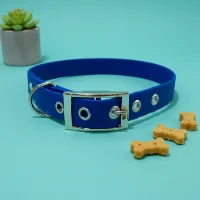
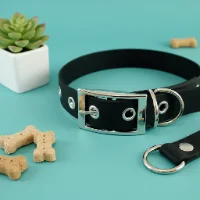
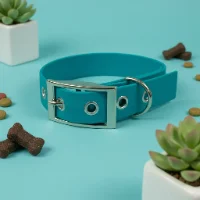
All our handmade collars at Dottie's adjust across their full stated size range, so you can dial in the fit precisely rather than settling for the nearest hole on a fixed-size collar. Our waterproof biothane collars are especially popular for medium breeds - fully adjustable, easy to wipe clean after muddy walks, and built to last through all weathers.