Dog Collars for Large Dogs: Your 20"–24" (46–61cm)
If you've got a large dog, you probably already know the drill - muddy paws after every walk, enthusiastic greetings that end up on someone's knees, and if you have a Labrador or a Golden Retriever, a neck that seems to vanish into a cloud of fur every time you try to check the collar fit. Getting the right large dog collar size matters more than many owners realise, not just for comfort but for genuine safety.
This guide covers the 20"-24" (approximately 51-60cm) collar size range, with specific tips for the UK's most popular large breeds. Whether you're buying a first collar for a new dog, replacing one that's well past its prime, or just double-checking you've got the right size, read on.
Is a 20"-24" the right large dog collar size for your breed?
This range suits dogs with neck measurements roughly between 20" and 24" (51-60cm). It's the most commonly needed collar size for UK large breed owners - Labrador Retrievers, Golden Retrievers, German Shepherds, and many other popular breeds sit comfortably here.
If you haven't taken a measurement yet, please do that first. Our step-by-step guide to measuring your dog's neck → walks you through exactly how to get an accurate reading - it takes two minutes and saves a lot of hassle.
Important: if your dog measures in the 23"-24" (58-61cm) range, it's worth checking our 24 to 28 inch collar guide → as well. A collar sitting right at the top of its adjustment range gives very little room to let out - and for a large dog who may fill out further, or whose collar needs to fit over a thick winter coat, that extra range can make a real difference.
Which breeds typically wear a 20"-24" collar?
Here's a breed-by-breed guide to the large dogs most commonly wearing this size range.
Labrador Retriever - 18"-24" (46-61cm)
Labradors are the UK's most popular dog breed - around 34,000 are registered with the Kennel Club every year - and collar sizing for them deserves proper attention. Male Labradors typically measure 20-24" (51-61cm), whilst females often sit in the 16-20" (41-51cm) range. But these are tendencies, not rules.
Always measure your own dog. A stocky male Lab at 38kg might comfortably wear a 23" (58cm) collar; a leaner individual of the same height might fit 20" (51cm). Don't assume based on sex, colour, or what the breeder's other dogs wear. Labs vary enormously, and the only reliable guide is a tape measure around your dog's actual neck.
If your female Labrador measures towards the smaller end, our 16 to 20 inch collar guide → covers her size range too.
Golden Retriever - 16"-24" (41-61cm)
Most adult Golden Retrievers land firmly in the 20-24" (51-61cm) range. The thing to bear in mind with Goldens is that beautiful, dense neck ruff - the collar sits underneath quite a lot of fur. Measuring over the coat (rather than at skin level) gives you the most practical size for everyday wear. It's also worth considering a slightly wider collar for a Golden - a wider style tends to show through all that fluff rather better.
German Shepherd - 18"-24" (46-61cm)
German Shepherds typically measure 18-24" (46-61cm), with many males sitting comfortably in the upper half of this range. The challenge with GSDs is their impressive neck ruff, which makes it genuinely difficult to judge the right size by eye.
Measure over the coat. Hold the tape snugly across the fur exactly as the collar will sit during day-to-day wear. Measuring at skin level, only to find the collar won't sit right over the ruff, is a very common mistake - and not one you want to discover halfway through a walk.
Dobermann - 18"-24" (46-61cm)
The Dobermann has a sleek, athletic neck that suits a well-fitted collar beautifully. Most measure 18-24" (46-61cm). A close-fitting, streamlined collar is ideal for this breed's build - nothing overly wide or chunky.
Rough Collie - 18"-22" (46-56cm)
Rough Collies (the Lassie breed, if you need a reference point) typically measure 18-22" (46-56cm). Like Goldens and GSDs, they carry a significant amount of coat around the neck, so measuring over the fur is essential for an accurate fit.
American Bulldog - 18"-24" (46-61cm)
American Bulldogs are powerfully built, with thick, muscular necks. They commonly fall in the 18-24" (46-61cm) range, though heavily built males may sit towards the upper end. When in doubt, choose a collar with more adjustment room rather than less.
Siberian Husky - 16"-22" (41-56cm)
Larger adult Huskies can reach 20-22" (51-56cm), though many females and lighter-built males sit closer to 16-20" (41-51cm). If your Husky falls towards the smaller end, our 16 to 20 inch guide → is a good starting point.
Belgian Malinois - 18"-22" (46-56cm)
The Malinois is lean and powerfully built, with a finely muscled neck. Most measure 18-22" (46-56cm). These are highly active, agile dogs - precise collar fit matters, and anything that slips is a safety concern.
Standard Poodle - 18"-22" (46-56cm)
Standard Poodles have elegant, well-proportioned necks and generally measure 18-22" (46-56cm). If your Poodle is in a longer clip, measure over the coat just as you would for any heavily coated breed.
Rhodesian Ridgeback - 18"-24" (46-61cm)
The Ridgeback is a powerful, athletic breed - and their necks reflect that. Most measure 18-24" (46-61cm), with larger males often sitting towards the upper end of the range.
The 2-finger rule - why it really matters on large dogs
Whatever breed you have, the 2-finger rule applies: once the collar is fitted, you should be able to slide two fingers comfortably between the collar and your dog's neck. Not three fingers, and not struggling to fit one.
For large dogs, this rule carries extra weight. A collar that's slightly too loose on a strong, determined dog is a genuine escape risk - an enthusiastic Labrador or an excited GSD can slip out of an ill-fitting collar before you know what's happened. Too tight, and you're causing real discomfort for a dog that might be working hard on the lead for hours at a time.
If you're ever unsure about the fit once the collar is on, our measuring guide → covers exactly what to look for - including how to check the 2-finger rule properly.
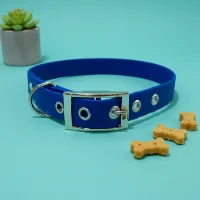
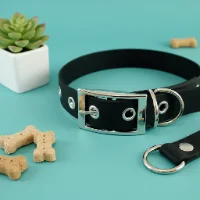
Biothane collars - a practical choice for muddy, active dogs
If your large dog is the type to enthusiastically investigate every muddy ditch, river bank, and waterlogged field they encounter (Labrador owners: you know exactly what we mean), a biothane collar is well worth considering.
Biothane is a coated webbing material that's completely waterproof, impressively strong, and wipes clean in seconds. No soggy collar drying out on the radiator for three days. No scrubbing at fabric to shift stubborn mud. Just a quick wipe with a damp cloth and it's good as new. For large, active dogs who spend serious time outdoors in the great British weather, it's one of the most practical collar materials going.
Frequently asked questions
What collar size does a Labrador need?
Male Labradors typically need a collar in the 20"-24" (51-61cm) range; females often fit 16"-20" (41-51cm). That said, always measure your own dog - Labradors vary considerably in build, and the only reliable guide is a tape measure around their actual neck.
What collar size does a German Shepherd need?
German Shepherds typically need a collar in the 18"-24" (46-61cm) range. Because of their thick neck ruff, always measure over the coat rather than at skin level to get an accurate fit.
What collar size does a Golden Retriever need?
Most adult Golden Retrievers fit a 20"-24" (51-61cm) collar. Measure over the coat - the dense neck ruff makes it difficult to judge the right size by eye alone.
How do I check a large dog collar fits correctly?
Once fitted, you should be able to slide two fingers comfortably between the collar and your dog's neck - this is the 2-finger rule. If you can't fit two fingers, the collar is too tight; if there's room for three or more, it's too loose.
Explore the full collar size range
Our full Dog Collar Size Guide → covers every size in one place - useful if you're shopping for multiple dogs or want to compare ranges. Or jump straight to an adjacent size:
16 to 20 inch collar guide → - for medium-large breeds including Border Collies, female Labradors, and smaller Huskies
24 to 28 inch collar guide → - for giant breeds who need a little extra room