Dog Collars for Medium to Large Dogs: Your 16"–10" (40–50cm)
Medium-to-large dogs come in wonderfully varied shapes - but if you're searching for a dog collar in the 16 to 20 inch (40-50cm) range, you're in the right place. From the lean, regal Greyhound to the barrel-chested Staffie, the tireless Border Collie to the spotted Dalmatian, this bracket covers some of the UK's most beloved breeds. Getting the fit right matters more than you might think, because this size range includes a few breeds with genuinely specific collar considerations. Read on, and we'll cover everything you need.
Is a 16-20 inch collar right for my dog?
This size range takes in some of the UK's most popular and beloved breeds. It's a broad bracket - spanning muscular, compact dogs like Staffies and lean, athletic types like Greyhounds and Dalmatians - but most adults in this group fall comfortably within the 16"-20" (40-50cm) window.
This page is part of our collar sizing series. If your dog measures a little smaller, our smaller collar size guide → may be a better fit. Bigger? Head to the larger collar size guide →. Or start with the full collar size guide → if you're not sure where to begin.
How to measure your dog's neck
Before you check any breed chart, grab a soft tape measure and take the measurement yourself - breed averages are a helpful starting point, but every dog is their own individual.
Wrap the tape around the widest part of the neck - for most breeds, this is roughly mid-neck. Note the measurement in both inches and centimetres; it makes comparing collar listings much easier.
The two-finger rule
Once you have a collar on your dog, use the two-finger rule to confirm the fit: slide your index and middle finger (held flat, side by side - not pointing upward) between the collar and your dog's neck. They should fit comfortably without forcing. If you can barely get one finger in, the collar is too tight. If your whole hand slips through easily, it's too loose.
For thick-coated breeds - Border Collies and Afghan Hounds especially - always part the fur before measuring, and double-check the two-finger rule once the collar is actually on. A heavy coat can make a poorly fitting collar look perfectly snug from the outside.
A special note for Greyhound and sighthound owners
If your dog is a Greyhound, Lurcher, Saluki, or Whippet, please read this section carefully - it could prevent a very stressful escape.
Sighthounds have a unique neck anatomy: the neck is narrowest at its mid-point, and widens again just below the skull, where the jaw muscles meet the top of the neck. This means that measuring mid-neck (as you would for most dogs) gives you a smaller figure than the true widest point of the neck.
A collar fitted to that mid-neck measurement will be narrower than the widest point. When a sighthound pulls back or startles, the collar can slide forward towards the skull - hit the wider circumference - and slip clean off over the head. It happens quickly and often without warning.
The fix: measure just behind the ears
For any sighthound, measure at the widest point of the neck - just behind the ears and under the chin, where the skull meets the neck. This circumference is larger than mid-neck. A collar sized to this measurement cannot slip forward and over the head, because it would have to pass through the narrower mid-neck section to escape.
Martingale collars for sighthounds
Most Greyhound owners - and most Greyhound rescue organisations - use a martingale collar (sometimes called a hound collar or limited-slip collar). It sits loosely on the neck at rest, but tightens gently if the dog pulls back, preventing escape without choking. There's a built-in stop point so it never closes fully. They're the sighthound standard for very good reason.
The same applies to Afghan Hounds - measure at the widest point of the neck and consider a martingale for added security.
Breeds in the 16"-20" range
Border Collie - 16"-18" (41-46cm)
The typical Border Collie neck size is 16"-18" (41-46cm). One of Britain's most popular working and family breeds - consistently in the Kennel Club's top breeds by registration - intelligent, tireless, and deeply connected to their owners. Whether your Collie is actually working sheep or channelling that energy into agility classes and long countryside walks, they need a collar that stays properly in place through everything they throw at it.
Measure regularly: a fit, active Collie's muscle mass can shift with the seasons and workload. The longer, thicker coat of a rough-coated Collie can disguise a collar that's gradually become too loose - always check by feel, not just by eye.
Staffordshire Bull Terrier - 16"-20" (40-50cm)
The collar size for a Staffordshire Bull Terrier is typically 16"-20" (40-50cm). The Staffie: Britain's most popular terrier, and arguably one of the most affectionate dogs in existence. They're enthusiastic about absolutely everything - bounding through muddy fields, squeezing into laps three times too small for them, and living life at full volume.
That powerful, muscular neck means you want a collar that won't stretch, fray, or hold onto the smell of every puddle your dog has investigated. Very large or heavily built Staffies may measure above 20" (50cm) - if that's your dog, do check the larger collar size guide → too.
Greyhound - 16"-20" (41-50cm)
Greyhound collar size in the UK typically sits at 16"-20" (41-50cm) - but the measuring method makes all the difference. See the sighthound section above - the behind-the-ears measuring technique is essential for Greyhounds. This is especially important for recently rehomed ex-racing dogs, whose owners are often new to the breed's specific needs. The Greyhound Trust and many other rescue organisations specify martingale collars as a condition of rehoming - and it's easy to see why.
Boxer - 16"-22" (41-56cm)
Boxers are brachycephalic - they have a shortened skull and a compressed airway, which means collar pressure on the trachea carries a real risk of discomfort or injury, particularly when the dog pulls. The sensible approach: keep a well-fitted collar with ID tags (UK law requires dogs in public to wear identification), but attach the lead to a harness for all walks. If using the collar only, ensure it sits high on the neck away from the throat and apply the two-finger rule with extra care.
Weimaraner - 16"-22" (41-56cm)
Weimaraner collar size typically spans 16"-22" (41-56cm). Most adults fall in the 18"-22" (46-56cm) part of this range; adolescents and smaller females may measure at the lower end. Very large adults can edge upward into the 20"-24" bracket.
Dalmatian - 16"-20" (41-50cm)
The collar size for a Dalmatian is consistently within the 16"-20" (41-50cm) window - athletic, lean, and reliably sized. Dalmatians also have a certain presence that rewards a collar that does the dog justice - a handmade collar in a bold colour suits them very well indeed.
Standard Dachshund - 16"-20" (40-50cm)
One important clarification: Standard Dachshunds fall in this range. Miniature Dachshunds are considerably smaller - typically 8"-17" (20-43cm) - so do confirm which type you have before ordering. The size difference is more significant than many owners expect.
Basset Hound - 17"-20" (42-51cm)
The Basset Hound is deceptively thick-set around the neck for what might look like a medium dog. The collar should sit well up on the neck - not close to the shoulders.
Airedale Terrier - 16"-24" (41-61cm)
The King of the Terriers has a wide range of builds depending on sex. Smaller females sit comfortably in this bracket; larger males can overlap with the 20"-24" range.
Afghan Hound - 16"-20" (41-51cm)
Elegant and sighthound in nature - the behind-the-ears measuring technique applies here too. The Afghan's glorious long coat makes it particularly easy to miss a collar that's drifted out of position, so always measure with the fur parted.
English Springer Spaniel (larger adults) - 16"-18" (41-46cm)
Springers typically measure a little smaller than this range, but larger adults can reach the 16"-18" bracket. If your Springer is on the smaller side, the smaller collar size guide → will serve better.
What collar material works best for this size range?
Medium-to-large breeds tend to be active, outdoorsy types. Border Collies cover serious miles. Staffies treat every walk like a full-contact sport. Even a retired Greyhound will insist on a proper outing in all weathers - because this is Britain, and the weather doesn't stop anyone.
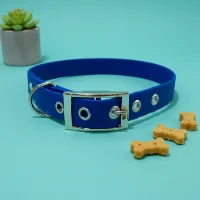
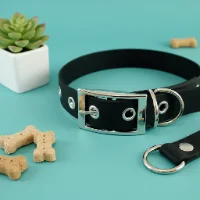
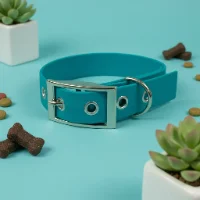
For breeds in this range, our handmade biothane waterproof collars are an excellent choice. Biothane is completely waterproof - it doesn't absorb water, mud, or bacteria - and wipes clean with a damp cloth in seconds. It doesn't trap that persistent wet-dog smell that fabric collars seem to hold onto forever, stays soft and pliable in both summer heat and January cold, and outlasts fabric options significantly. For a Staffie whose collar takes real physical punishment, or a Dalmatian whose collar should look as sharp as the dog wearing it, biothane makes a genuine difference.
Not in the right range?
Collar sizing isn't always clear-cut - Boxers and Weimaraners in particular can sit at the boundary between two ranges. Here's where to head next:
Smaller: 12-16 inch collar size guide →
Larger: 20-24 inch collar size guide →
Need to measure first? how to measure your dog's neck →
Browse the full series: full collar size guide →